Skip to content

Speaking at next09 conference in Hamburg, Germany (May 5 & 6)

next09 logoShortly after I blogged about my upcoming talks and events, I got informed that one of my session proposals for the next09 conference was accepted. This event will take place in Hamburg, Germany on Tuesday and Wednesday (5th and 6th of May), so at least there isn't much travel involved.

My talk about "Working for a Virtual Company: How we do it at MySQL" has been scheduled for 9:00 am on Wednesday morning, parallel to a keynote by Brian Solis from FutureWorks. I'm not sure how many people will actually show up, but I look forward to giving a talk about a less technical subject for a change! I'm going to share my experiences how it's like working in a virtual company of our scale and talk about some of the key aspects of what makes this model work. If you happen to be in Hamburg at that time, consider attending the conference!

The conference program looks quite interesting and there are quite a few well-known names on the speakers roster. Considering that I'll also be giving two talks about MySQL at AMOOCON on Monday that very same week, it'll be some busy times...

My upcoming talks and events

My calendar for the upcoming months is already filling up with conferences, trade fairs and other events at which I'll speak about MySQL. Here's a quick overview:

  • This coming Thursday at 15:00 CET, I'll be speaking about "Backing up MySQL using file system snapshots" at the MySQL University. The session will be hosted live using DimDim, which is a great online conferencing and presentation system (Flash required). Attendance is free, so come and join me if you want to learn more about this backup technique!
  • On Friday, 6th of March at 15:15 I'll give a presentation about "MySQL Backup and Security" in the CeBit Open Source Forum in Hannover, Germany. By the way, Sun will have a large presence themed "Open Source for Open Minds" in Hall 6, Booth E36. There'll be a MySQL info pod as well, which I will help manning from Friday until Sunday, 8th. So make sure to stop by and say hello!
  • On March 23-24, there'll be a PHP/MySQL Conference in Warsaw, Poland, organized by IDG. I submitted three talks about various MySQL topics, currently I am still waiting for the confirmation which of these they selected.
  • On April 20-23, there is of course the MySQL Conference & Expo in Santa Clara, to which I am very much looking forward to. I'm helping to organize the DotOrg Pavilion in the exhibition hall and will likely give a BoF about a project I'm currently involved in.
  • In May 4-5 there is the AMOOCON in Rostock, Germany, which is a conference about Open Source VoIP and communication. I'll talk about "MySQL High Availability Solutions" and "Backup & Security Best Practices" (in German). My colleague Geert will be there as well, giving an in-depth talk about MySQL Cluster.

There is a number of additional events in the pipeline, I'll blog about these once my session proposals have been accepted.

Site is (almost) back...

Sorry for the downtime of this site - until around a week ago I hosted my home page on a trusty Genesi Pegasos II system (powered by a PowerPC G4 Processor clocked at 1GHz, using Debian 4.0 PPC with 512 MB of RAM), serving these pages from my home DSL connection. Unfortunately this system provided no means of redundancy - the hard disk drive died.

Luckily I perform frequent backups, so I moved most parts of the site to a shared hosting space now - the picture gallery is unfortunately too big to fit into the space that I have there. I'll try to move the pictures into my Flickr account instead, but this will take some time.

Note that the primary domain name of this site is now lenzg.net - lenzg.org, (the domain that I tried to promote as the official domain for my site) used to redirect to the home machine at lenz.homelinux.org. Both now redirect to the new address instead. I've initiated the move of the lenzg.org domain to the other provider as well, so soon this site will be available from both the .org and .net domain. Please don't link to lenz.homelinux.org anymore, as that site will eventually go out of service. Until then, a small openSUSE Linux box (Intel PIII, 500 MHz, 192 MB of RAM) running lighttpd will perform the URL redirection.

Schedule of the MySQL Developer Room at FOSDEM 2009 finalized and published

We've now concluded our call for papers for the MySQL Developer Room at FOSDEM 2009 in Brussels, Belgium, which will be open on Sunday, 8th of February from 09:00-17:00.

We received some excellent proposals and I am very excited about the schedule. Here's the quick summary of the talks:

  • Vladimir Kolesnikov: Practicing DBA's Guide to the PBXT Storage Engine
  • Kris Buytaert: Monitoring MySQL
  • Geert Vanderkelen: MySQL Cluster
  • Roland Bouman: MySQL 5.1 Plugins
  • Kaj Arnö: MySQL, powering and using Social Networks
  • Ewen Fortune: Percona MySQL patches and the XtraDB storage engine
  • Giuseppe Maxia: Boost performance with MySQL 5.1 partitions
  • Jurriaan Persyn: Database Sharding

See the Schedule page on the MySQL Forge for the detailed agenda, including the detailed session abstracts and speaker bios. These talks will soon appear in the general FOSDEM schedule, too. If you are interested in MySQL and any of the topics above, consider visiting us in Room AW1.126! Participation and attendance is totally free, though the organizers happily accept donations and sponsorships.

In addition to the Developer Room, MySQL will share a project desk with the OpenSolaris community. We are still looking for at least one more volunteer that would help us with manning the desk! If you are interested in helping out (2 hours at a minimum), please drop me a line!

Updating from MySQL 5.0 to 5.1 - what's your experience?

Now that MySQL 5.1 has finally been labeled and released as "GA", we have noticed quite a significant increase in the download numbers for 5.1. I find this quite promising, despite the comments from some people that suggested to stay away from it for now. I performed updates of 5.0 to 5.1 several times already, and did not observe any serious problem so far. But then again, I am by no means a power user, so your mileage may vary...

I assume that many of the users are already using some older versions of MySQL and will have to perform an upgrade from the previous version to the new one. As many things have been changed and improved between 5.0 and 5.1, an upgrade needs to be planned carefully. The MySQL reference manual has an entire chapter devoted to this subject. The best general advice is probably to create a backup of your data first before attempting to upgrade!


I performed an upgrade test on an openSUSE 11.0 system that was running on the MySQL version shipped with the distribution (5.0.51a). I first loaded it with some databases that I copied from other live systems (via SQL dumps). Then I grabbed the Server, Client and shared library RPMs the "Linux x86 generic RPM (dynamically linked)" section of the 5.1 downloads page and installed them with rpm -Uhv MySQL-server-5.1.30-0.glibc23.i386.rpm MySQL-client-5.1.30-0.glibc23.i386.rpm MySQL-shared-5.1.30-0.glibc23.i386.rpm. The packages were installed without a hitch and properly replaced the existing 5.0 packages (even though they use different package names). I then restarted the server and ran mysql_upgrade afterwards.


Success! I was pretty impressed how smooth this upgrade was performed. So far, I did not notice any regression or incompatibility. But I would be interested in hearing stories and comments from other users about their upgrade experiences!

So here are some questions I would like you to answer — I would appreciate your feedback either via this blog or by email to firstname at sun dot com:

  • What are your expectations and most important requirements for performing MySQL upgrades?
  • Have you upgraded to MySQL 5.1 yet?
  • If not, why not?
  • If yes, what was your upgrade experience like? Any serious issues or problems? What platform and package format did you use?
  • Did you use the documentation in our reference manual to perform the update? Was it helpful? What could be improved?
  • Do you have any other comments/suggestions on the topic of upgrading MySQL?

I am looking forward to your comments. Thanks and Happy Holidays!

PlanetMySQL now available in Italian as well!

FYI, we've now added an Italian section on Planet MySQL: http://it.planetmysql.org

If you are a MySQL enthusiast from Italy and would like to start blogging about it in your native language, please consider submitting your feed for inclusion!

Giuseppe just recently started blogging in Italian as well and has already added his feed there.

MySQL@FOSDEM 2009: Call for participation

The FOSDEM 2009 organizers have been very kind to us this year: in addition to a Developer Room on Sunday, we now also have a project desk (1 table) on both days! Thank you very much! In summary, this means that there will be the following MySQL-related activities:

  • We will have a Project Stand (one table) on both days
  • On Sunday, we will have a MySQL Developer Room, allowing us to schedule our own track of talks about MySQL and related projects
  • I have been invited to give a talk about "MySQL High Availability Solutions" in the main conference track
  • I also submitted two proposals for lightning talks ("What's new in MySQL 5.1" and "Why you should use Bazaar for maintaining your OSS project") (pending approval)

In addition to employees from Sun/MySQL, we would also like to encourage and invite members of the MySQL Community to contribute to making the MySQL project's presence a success. We are looking for your support and contribution! Here is how you can help:

Give a talk about MySQL in the developer room

The MySQL Developer Room will be open on Sunday, 8th of February, from 9:00-17:00. We would like to set up a schedule of talks related to MySQL. As the audience will mostly be developers and DBAs, we are looking for in-depth technical sessions about the MySQL Server and related projects/tools (e.g Cluster, Proxy, Connectors, etc.). Each session will last for 45 minutes, followed by 15 minutes of Q&A.

If you would be interested in giving a talk, please submit your proposal via this page now! The deadline for proposing a talk is January 15th, 2009. We look forward to your submission!

After the call for papers has been closed, we will comment and vote on all proposals and will get back to you about further details!

Record/transcribe sessions

For people that could not make it to FOSDEM or some of the sessions, it would be nice to be able to provide video recordings or transcriptions (e.g. live blogging) from these talks. We're looking for volunteers to record the sessions! If you have a video camera or are an expert blogger, we'd like to hear from you.

Help us manning the project stand

We are also looking for MySQL users that are willing and excited to talk about MySQL to other people and would like to assist us with manning our project desk. Your task would be to be present at the project table, talk with other users and developers about all things MySQL, hand out merchandise (in case we get some) and marketing material as well as providing them with additional useful information (e.g. links to further information, contact information).

So if you are a MySQL enthusiast and plan to attend FOSDEM, consider sparing at least two hours and join us to man the table! I've set up a quick registration form in which you can leave your name, contact information and times you would be available. We will then get back to you about further details. Thank you!

Contact / Mailing list

To facilitate the organization and for further discussion, please join our public Community mailing list! I've also set up a Wiki page on the MySQL Forge to track and document our FOSDEM 2009 activities. I am looking forward to your feedback and suggestions!

mylvmbackup-0.11 has been released

Some days ago, I released version 0.11 of mylvmbackup a Perl script that performs consistent backups of a MySQL server by using LVM filesystem snapshots. The source archive as well as a generic RPM can be found on the project home page, packages for many Linux distributions are available on the openSUSE Build service.

This release includes some new functionality as well as numerous bug fixes and improvements, most notably:

  • Added support for using rsnap as a backup backend (Matt Lohier)
  • The documentation is now maintained in POD style instead of asciidoc (Matthew Boehm)
  • Support using non-GNU tar and additional compression methods (e.g. bzip2, lzma) (Alexander Skwar)
  • Code cleanups, improved error handling and logging

I would like to thank all the contributors for their support! More details about the changes in this release, directly from the ChangeLog:

  • Added new option "--quiet" that suppresses informal logging output (warnings and errors will still be printed/logged)
  • Applied patch from "kjetilho" that makes mylvmbackup more robust and paranoid when it comes to handling errors/failures (Bug #298175) Now the script aborts cleanly in case of any error.
  • Fixed error handling in case of a failed DB connection (patch submitted by Matthew Boehm, Bug #280989)
  • Merged changes from Alexander Skwar: Fix for Bug #278478 and implemented Blueprint "Improve the tar backup backend of mylvmbackup"
  • Fixed Bug #271671: "overloading parameters does not work" by removing the default values for host and port from the configuration file and removing the unnecessary check for passing both host and socket at the same time. Updated documentation and configuration file comments accordingly.
  • Applied patch suggested by "Jonas" to fix Bug #267944: "backup returns successfully when snapshot creation fails"
  • Code cleanup: moved flushing of tables in a separate subroutine flush_tables()
  • Code cleanup: moved log messages into the respective subroutines
  • Code cleanup: use return values of subroutines instead of updating global variables
  • Improved some log messages to explain what was DONE or FAILED
  • Code cleanup: build up long command strings in a $command variable before passing it to system()
  • Renamed subroutine create_snapshot() to create_lvm_snapshot()
  • Merged patch from Matthew Boehm: Removed old asciidoc documentation in favor of POD style. This removes the dependency on the external program a2x for creating documentation and uses the 'built-in' pod2html and pod2man instead. Updated the Makefile to accommodate the change.
  • Applied patch from Matthew Boehm to make the backup file name suffix configurable via a "--suffix" option. Updated the man page accordingly.
  • Applied patch from Matt Lohier to support rsnap as a backup backend 
  • Moved the list of contributors from the man page into a separate CREDITS file, added missing names

Enjoy!

MySQL@FOSDEM 2009 (Feb 7/8, Brussels, Belgium)

I'm going to FOSDEM, the Free and Open Source Software Developers' European Meeting

FOSDEM 2009, one of the biggest European Open Source conferences, will take place on February 7-8 in Brussels, Belgium. Today I received a confirmation from the organizers: MySQL will have a developer room on Sunday, the 8th! This is very cool.

My idea was to organize some kind of MySQL mini-conference, with a focus on developers and DBAs. I am going to send out a more formal CfP soon, but if you have any ideas or suggestions for a talks/sessions already, please get in touch with me!

In addition to the devroom, I have also been invited to give a talk about MySQL High Availability solutions in the conference main track. In this talk I plan to cover some commonly used HA setups for MySQL, including the OSS components/tools (for Linux and OpenSolaris) involved. I will mention MySQL Cluster as well, explaining the relationship and architecture of MySQL Server and NDB Cluster. I hope this will be of interest to the audience.

I also submitted two lightning talk proposals: "New features in MySQL 5.1" and one about "Why you should use Bazaar for maintaining your OSS project", but I won't know if these were accepted until the end of December...

See you there!

Using a serial mouse via USB on OpenSolaris

As noted in my previous blog posting, I manged to revive my old Logitech TrackMan Marble FX on Linux (openSuSE 11.1b4), using a Serial-to-USB dongle with a Prolific PL2303 chip. But I also use OpenSolaris on my Laptop quite frequently (currently testing the upcoming 2008.11 release), so I investigated if it would be possible to enable the trackball there as well.

Luckily, the Driver Manager listed the plugged in adapter and the correct driver (usbsprl) was loaded already. Now the real challenge was finding out which device node to use. Some research revealed that the driver actually comes with a manual page , which indicated that /dev/term/0 was the correct device name.

Lo and behold, I copied the InputDevice section from my Linux xorg.conf file into the OpenSolaris one, replaced the Device parameter with the appropriate one and restarted the X server. Immediate success! Now I can enjoy using my most favourite input device on OpenSolaris as well.

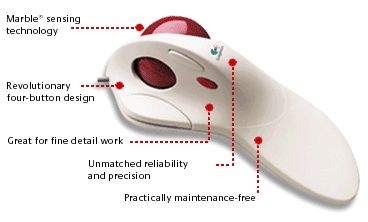
Reviving my old Logitech TrackMan Marble FX

Logitech TrackMan Marble FX

I am probably different than most users, but I am a a fan of unusual input devices. I prefer Laptops with trackpoints - I immediately disabled the touchpads on my Lenovo laptops (a T61 and T42) in the BIOS when I received them. My first Laptop (a Toshiba Portege 3440CT) didn't even have a touchpad to begin with. It's a pity that trackpoints seem to a dying breed.

And I don't like using regular mice on my desktop, either! Actually, my most favourite input device is a trackball - I purchased a Logitech TrackMan Marble FX a long time ago, and used it for years. Then computers stopped having serial or PS/2 connectors, and I replaced the trackball with an USB mouse. I never really got the hang of using mice, but Logitech (or other vendors) somehow never came up with a suitable replacement model for the Marble FX with a USB port. I recently looked at the Logitech Trackman Optical, but was not convinced by the reviews I read, and the fact that it requires batteries (a trackball is a stationary device, so a cable does not really interfere here!). The Microsoft Trackball Explorer might have been an option, but it seems to be impossible to get nowadays.

After experimenting with several mouse models (Cherry, Microsoft), I decided to revive the TrackMan Marble again. It comes with a PS/2-connector by default, so I first tried to connect it to my PC using a PS/2-to-USB converter dongle. This actually worked without any tweaking, but had two limitations: the fourth mouse button was not detected anymore (I could have lived with that) and the Trackball stopped responding after it had been idle for a while, requiring me to restart the X server to get it working again.

So using the PS/2-to-USB dongle was ruled out and I tried an Serial-to-USB dongle instead:

lenz@thebe:~> lsusb|grep Serial
Bus 002 Device 006: ID 067b:2303 Prolific Technology, Inc. PL2303 Serial Port

When plugged in, udev creates a new serial device /dev/ttyUSB0 which I needed to inform the X server about. Fortunately it's possible to define multiple input devices in the xorg.conf configuration file. Using the serial port actually had another advantage - I was able to add some trackball-specific tweaks that would have collided with the settings of the "regular" PS/2 mouse section that I needed for the builtin trackpoint of my Thinkpad. It required some tweaking and testing, but this is what I added to xorg.conf to be able to use the TrackMan Marble FX in addition to the builtin pointing device:

Section "ServerLayout"
    Identifier     "Layout0"
    Screen      0  "Screen0" 0 0
    InputDevice    "Keyboard0" "CoreKeyboard"
    InputDevice    "Mouse0" "CorePointer"
    InputDevice    "Trackball" "SendCoreEvents"
    Option         "Clone" "off"
    Option         "Xinerama" "off"
EndSection

Section "InputDevice"
    Driver       "mouse"
    Identifier   "Trackball"
    Option       "Device" "/dev/ttyUSB0"
    Option       "Name" "TrackMan Marble FX"
    Option       "Protocol" "Intellimouse"
    Option       "Vendor" "Logitech"
    Option       "AngleOffset" "10"
    Option       "Buttons" "8"
    Option       "Emulate3Buttons" "off"
    Option       "EmulateWheel" "true"
    Option       "EmulateWheelButton" "8"
    Option       "YAxisMapping" "4 5"
    Option       "EmulateWheelInertia" "8"
EndSection

You may wonder about the 8 mouse buttons, as the device only has four physical buttons. Interestingly, the fourth button on the TrackMan reported itself as "button 8" when I probed it with "xev", so I needed to make sure the server is aware of it. When pressed, the trackball now acts like a mouse wheel and allows me to quickly scroll across long documents - very handy! Now I just hope that the button switches in the TrackMan last for another while - until some vendor eventually comes up with a suitable replacement...

Celebrating Software Freedom Day in Riga, Latvia

Software Freedom Day 08As I mentioned some time ago, Software Freedom Day 08 will take place on Saturday, 20th of September 2008.

Coincidentally, the a large number of Sun/MySQL Engineers and other Sun folks will be in Riga, Latvia for an internal developer meeting around this day. To make use of this opportunity, we plan to give a number of sessions and presentations (in english) about various topics and to contribute to this global celebration of Open Source Software.

We've set up a Team Page on the Software Freedom Day web site for this event - the venue will be the Cafeteria Conference room in the basement of the University of Latvia, Riga, which can accomodate 60-80 people:

Raiņa bulvāris 19
Rīga, LV-1586

There is no entrance fee and you don't have to register - just come by and meet with us! There will be free coffee, refreshments and cake during the breaks.

In the evening, Sun will host a social event (incl. free drinks and food) in the SAS Radisson Daugava hotel, starting at 19:30:

Radisson SAS Daugava Hotel
Kugu 24, Rīga, LV-1048, Latvia
Tel.:+371 6706 1147; Fax: +371 6706 1101

We've set up a tentative schedule (45 minutes per session plus 15 minutes of Q&A), please check the Wiki for eventual last-minute changes!

11:00-12:00: MySQL/Open Source in Latvia (Evijs Taube, Sun Microsystems)
12:00-13:00: Open Source Business Models: how to build a business around free software (Speaker TBD)
13:00-13:30: Lunch Break / Ask the Guru your tech questions
13:30-14:30: MySQL in the Enterprise: Customer references, commercial offerings (Rob Young/Robin Schumacher, Sun Microsystems)
15:00-16:00: MySQL Community Overview: How to engage and contribute (Giuseppe Maxia/Jay Pipes/Lenz Grimmer, Sun Microsystems)
16:15-17:15: MySQL Performance tuning best practices (Jay Pipes, Sun Microsystems)
17:15-18:15: Maintaining your Open source project with Bazaar and Launchpad (Lenz Grimmer/Giuseppe Maxia, Sun Microsystems)
19.30: Social event: Software demonstration, buffet and free beer in the SAS Radisson Daugava hotel

We'd like to thank Leo Trukšāns, Michael Dexter and Georg Richter for their help and support in getting this event arranged and organized! I look forward to being there and help to spread the word about the stuff that keeps me occupied for more than 13 years now :-)

Project Kenai: looking at the technology behind it

Project Kenai LogoWhile Colin beat me in blogging about Project Kenai, I think I can still provide some additional background information about this new project hosting service from Sun.

If you are a maintainer of an Open Source project, you currently have plenty of choice when it comes to getting your project hosted for free. One criterion could be your software configuration management system (SCM) of choice.

Some of the hosting services that I am currently aware of and the choice of SCM they offer include:

As disclosed by Tim Bray some days ago, there now is another option - Kenai is open for project hosting (currently by invitation only)! In his blog post, he interviews Nick Sieger, one of the developers behind this project about their motivation and intentions:

We need to demonstrate credibility in building on top of more traditional LAMP/SAMP web stacks (not just Java EE); and we need to show viability of Sun technologies and hardware for next-generation web applications.

In a nutshell, Kenai is a platform for:

  • Developer collaboration
  • Communities of connected developers
  • Integrated collaboration services stack

Some of the features that are currently available include:

  • SCM services using Subversion and Mercurial
  • Bug Tracking (Bugzilla)
  • Forums
  • Wikis
  • Mailing Lists (using Sympa)

Reading the interview with Nick and looking at some presentations slides for RailsConf from Fernando Castano (a jRuby and Database performance engineer at Sun and another member of the project team),  I was able to gather a list of the tools and technologies they used to build Kenai:

I found it interesting that they decided to deploy and run the Rails application as a war file within the Glassfish application server (using Warbler). By the way, the fabolous OpenSUSE Build Service is a Rails application, too! So far, the entire site is powered by a single MySQL instance with query cache enabled.

The project is hosted on the following infrastructure:

You should check out Fernando's presentation for more technical details, tuning info and how they benchmarked the setup - it contains a number of useful tuning hints and performance graphs.

Last time I checked, 27 Projects have joined so far (e.g. jRuby, xVM Server). Kenai itself is developed on Kenai. It's going to be interesting what other projects will find their home there.

Nick also talked a bit about their future near term plans: to improve the usability and feature set, incrementally improve the site navigation and layout and adding support for hosting files/release downloads. They also consider offering Jira as an option to Bugzilla for bug tracking and Git as another SCM option.

There is an IRC channel #projectkenai on freenode.net, to get in touch with the developers directly. The mailing list for the Project Kenai site itself, is users@help.kenai.com - you can subscribe to this list here.

MySQL University Session tomorrow: OpenSolaris Web Stack

MySQL UniversityTomorrow (Thursday, 11th of September) at 9:00 PST/16:00 UTC/17:00 GMT/18:00 CET, there will be an new free MySQL University Session. MySQL University started as an internal training program for MySQL engineers, to share and spread knowledge about their areas of expertise and has been available to the public for quite some time now. It covers a wide range of technical topics around the MySQL Server and usually takes place once per week.

For the first time, the presentation will not be performed by (former) MySQL employees/developers, but by two of our "Sun Classic" colleagues: Jyri Virkki (OpenSolaris Web Stack community lead) and Murthy Chintalapati (Sr Engineering Manager, Web Stack development) will talk about the OpenSolaris Web Stack:

OpenSolaris Web Stack is an OpenSolaris project and community building an integrated stack of popular open source web tier infrastructure technologies such as Apache HTTP server, MySQL, memcached, PHP and Ruby On Rails optimized for Solaris platform. This session introduces OpenSolaris Web Stack, its status and future development including addition of newer technologies such as lighttpd, Varnish etc., as well as the ease of use features for developers and deployers. We will also be discussing an experimental web stack IPS package repository and it could be leveraged to build and make available popular end user applications such as Drupal.

MySQL University sessions are free to attend - all you need is an IRC client (to post your questions and comments) and an audio player capable of playing back an OGG audio stream, so you can listen to what is being said. See the Instructions for Attendees on the MySQL University pages for more information on how to log in and attend. The audio stream will be recorded and published on the MySQL University pages for later consumption, in case you can't make it or want to listen to a previous session.


More slides and pictures from DrupalCon and FrOSCon

I'm back home from DrupalCon 2008 now - it has been a great event! I met a lot of nice people from the Drupal Community and learned a lot about this CMS. I've been very busy in uploading the remaining pictures from the event to my gallery - so here's for your viewing pleasure:

I also gave two talks and held a BoF there - the slides have now been attached to the session nodes, one of them (the HA session) even includes a video recording:

I've also uploaded some pictures from FrOSCon to my Gallery now, hope you enjoy them! The slides of my FrOSCon talks are now uploaded to the conference system as well:

tweetbackcheck